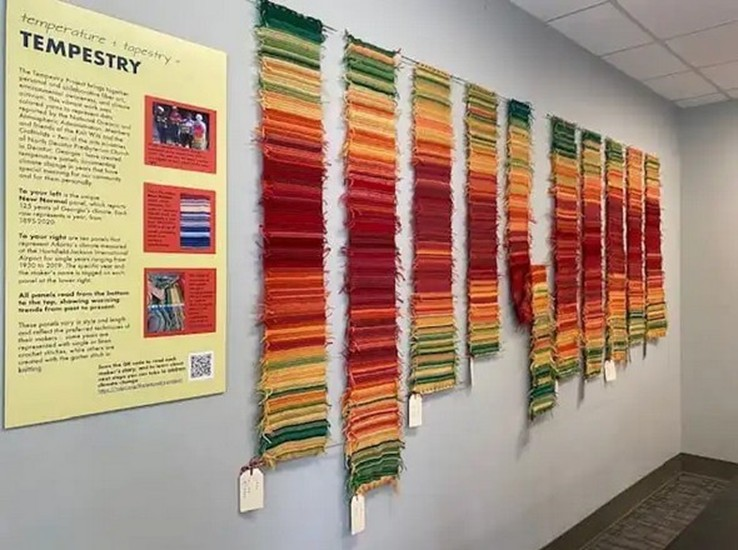
The Mid-Hudson Library System has partnered with The Tempestry Project on a large-scale community art project to depict climate data from the Hudson Valley from 1895-2025 in the form of “tempestries” knit by artisans across the Hudson Valley.
Knitters and knitting groups in the MHLS member libraries have worked together to create this one-of-a-kind traveling exhibit to tell the story of not just climate change, but the history of libraries in the region and the personal histories of the knitters. Each Tempestry tells a story…
Mid-Hudson Libraries Tempestry Collection Exhibit Schedule
May – June 2026: Hyde Park Library District
July – September 2026: Mahopac Library
November – December 2026: Olive Free Library
January – March 2027: Elting Memorial LIbrary
April – June 2027: Hudson Area Association Library
July – September 2027: Claverack Free Library
October – December 2027: Putnam Valley Free Library
What is a Tempestry?
A Tempestry (or temperature tapestry) is a knitted scarf-sized wall hanging that shows the daily high temperatures for a specific location and year. Collectively, a group of Tempestries for one location (such as the Mid-Hudson Libraries Collection) creates a powerful visual representation of changing temperatures over time.
Why Libraries?
The Mid-Hudson Library System (MHLS) works to create a world in which individuals, families and communities thrive when they have access to information, resources, learning environments and library services that respect the triple bottom line of social equity, economic feasibility, and environmental stewardship. The Mid-Hudson Library System is the first public library system in the country to be certified through the Sustainability Libraries Initiative’s award-winning Sustainable Library Certification Program.
Why the knitted linen stitch?
Knitted linen stitch creates a beautifully sturdy fabric that won’t stretch the way that crochet and knitted garter stitch do and won’t curl the way stockinette does. This works well for Tempestries, which may be displayed for long periods of time.